Today, Halloween is synonymous with pumpkins, fireworks, and trick or treating, but long before these modern traditions, there was Samhain, the ancient Celtic festival marking the first day of winter.
According to Victoria Millar, Senior Curator of History at the Ulster Folk Museum, Samhain signalled the beginning of the cold, dark, winter months of the year and was marked on 1st November. Much like the other seasons, most celebrations occurred the evening beforehand, on Samhain Eve, with the lighting of bonfires and feasting.
With the spread of Christianity, Samhain Eve later became known as All Hallows’ Eve. It fell the evening before All Saints' Day on 1st November, also known as All Hallows' Day, which commemorated the saints in heaven. This was followed by All Souls’ Day on 2nd November, which commemorated all departed souls, including those believed to be in purgatory. All Hallows’ Eve increasingly became associated with the dead who were thought to roam the land during this night.
Many of the customs that dominate our screens, take place in our neighbourhoods and festoon our homes each Halloween - such as costumes and pumpkin carving - have their roots in the traditions practiced on Samhain Eve and All Hallows’ Eve.
This October, the Ulster Folk Museum is bringing those traditions to life at its Halloween event. Running from Wednesday 29th to Friday 31st October, the museum invites visitors to experience Halloween for real, as it was in the early 1900s and to discover the influences of Samhain on Halloween traditions through the stories, crafts and customs preserved in the museum’s archives.
“Our archives are full of stories that are as chilling as they are captivating,” says Victoria. “Masks were worn, fires were lit and stories of ghosts, fairies, and even the devil, were shared to entertain, warn, or protect the household. These traditions give us a glimpse into the lives and imagination of people in Ulster around the turn of the 20th century.”
And of course, food was never far from these gatherings. Apple pies and barmbrack were baked with hidden charms - a ring, a coin, a thimble - each one carrying its own meaning. A lucky slice might foretell marriage or wealth, while another hinted at spinsterhood or misfortune.
Cabbages, too, played a surprisingly mystical role in customs for this time of year. “It’s incredible to think that something as ordinary as a cabbage could be used for divination,” says Victoria.
“Our archives hold some fascinating stories of how people would read cabbage stalks to tell the future. We have an account from Enniskillen of one young man who walked backwards into the cabbage garden to pull a stalk, the shape of which was said to predict the physique of his future wife. Whilst in Keady in County Armagh, the soil clinging to the cabbage stalk was thought to foretell prosperity. These small rituals offer a charming insight into how communities made sense of uncertainty and brought meaning to the changing seasons.”
And while today’s children go ‘trick-or-treating,’ in the past it was known as ‘guising’ or mischief night. Children and adults wore masks or ‘false faces’ to play pranks on neighbours – sometimes climbing on roofs, tying threads to door knockers, or placing small fireworks under doors, as recorded in Limavady, Portadown and Crossgar.
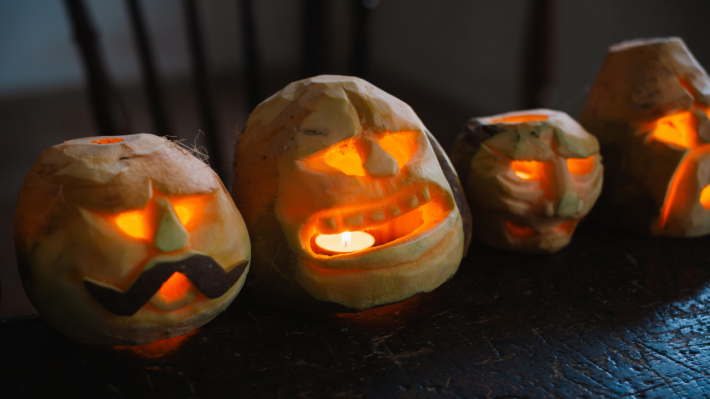
Victoria goes on to explain how the humble turnip was used long before the pumpkin as a lantern to ward off malevolent spirits.
“Today we reach for pumpkins because they’re softer and easier to carve and of course because of the American influence on Halloween,” advises Victoria, “but for centuries, turnips were hollowed out and made into lanterns, meant to frighten or amuse passers-by and to ward off fairies and spirits. They were the original Halloween lanterns - gnarled, misshapen and wonderfully unsettling.”
These customs remind us that Halloween has long been a celebration of imagination and fear, but above all, of connection – a night when the ordinary and the supernatural intertwined, and communities gathered to honour the mysteries of the season, reflect on the year gone by and prepare for the winter ahead.
Victoria concludes,
“Samhain and All Hallows’ Eve were ultimately social festivals. A time when even in the darkest part of the year, warmth and laughter could be found in company and shared stories. The Ulster Folk Museum has preserved these stories of Ulster’s shared heritage and through our work, we’re connecting visitors to the past through the lens of today. Ulster’s traditions are not relics – they are living systems of knowledge that continue to influence how we live today. These customs have shaped who we are and by celebrating them we are all learning how our past informs our future.”